












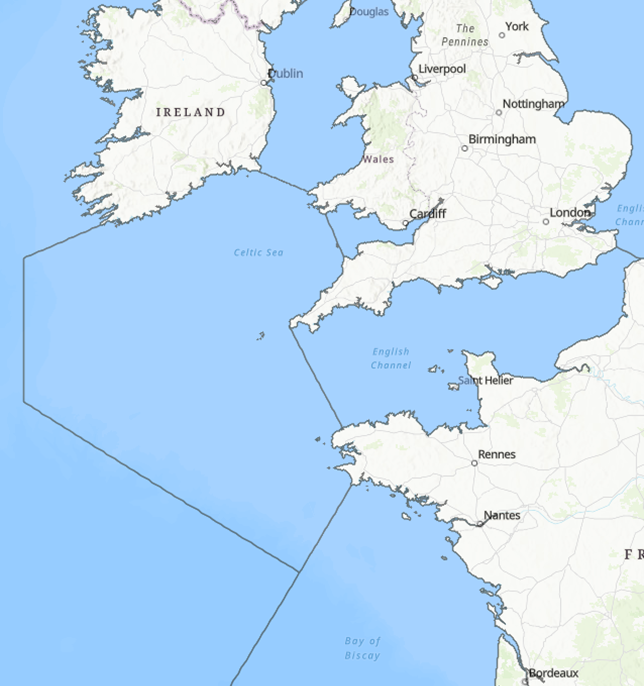

The name Celtic Sea Salt® traces its roots to both geography and ancient tradition, but its “Celtic” identity is more a story of inspiration than a strict regional definition. While today’s Celtic Sea Salt® comes from salt beds in France’s Bay of Biscay, the “Celtic” descriptor is not universally featured among the local producers, nor is it present in regional signage or branding.
Origins of the "Celtic" Name
In the mid-20th century, marine biologist Edouard Le Danois first popularized the term “Celtic Sea” for a section of the North Atlantic bordered by the Celtic lands of Ireland, Cornwall, Wales, and Brittany. The International Hydrographic Organization formalized its boundaries in 1953, but the area is distinct from the Bay of Biscay, the actual location of French grey salt harvesting.
Ancient Celtic Salt Harvesting
Through his travels, Jacques had discovered a method of harvesting salt dating back to the Celts in Europe. This harvesting method involved channeling sea water through an intricate inland system of canals and retention ponds, each gradually more shallower than the last. This process resulted in higher salt concentrations while preserving the mineral profiles of the sea and the local ecosystem. Then, by hand harvesting, the resulting salt would be higher in naturally occurring minerals than conventional processed table salt and alkaline (as opposed to acidic).
Inspired by this ancient method, he coined the term “Celtic Sea Salt,” now known as Celtic Sea Salt®, a registered trademark of Celtic Ocean International, LLC.
Brand Inspiration and Geographic Truths
Celtic Sea Salt® was created by Jacques and Selina Delangre to evoke a sense of heritage and craftsmanship associated with the ancient Celts. The name references not just the oceanic geography but also traditional harvesting methods that preserve the salt’s full spectrum of naturally occurring minerals. Despite being “viral” in modern culinary and nutrition circles, “Celtic” conveys more about method and meaning than strict regional origin.
Context in a Global Tradition
Interestingly, Mayan civilization also practiced sophisticated salt harvesting, notably in coastal lagoons using evaporation and retention ponds, preserving minerals while supporting local ecosystems. Like the Celts, Mayan methods prioritized sustainability, mineral richness, and environmental stewardship—parallels that underscore salt’s universal importance through history.
In summary, the name Celtic Sea Salt® is a blend of geographic inspiration, ancient European craft, and branding vision, connecting time-honored methods with today’s health-conscious consumers.
Map of the Celtic Sea

Sources & Additional Reading
- Le Danois, Edouard. Marine Life of Coastal Waters: Western Europe. 1957 (pp. 12)
- Arcgis.com/map apps confirmed on IHO map accessed 2 April 2025, https://www.arcgis.com/apps/mapviewer/index.html?layers=44e04407fbaf4d93afcb63018fbca9e2 verified
- Pingree, R.D. Elsevier Oceanography Series: Volume 24, Part B. Pg.415-465